
China is acutely conscious of the need for the next Dalai Lama to be under its control. It was for this reason that China recently stressed their claim on Arunachal Pradesh. There were rumours that the next Dalai Lama may be found in Tawang. If that happens, India-China relations will become tense and there may be demands for the child to be handed over to the Chinese, points out Ambassador T P Sreenivasan.

Senior officers recounted extreme Chinese brutality to the Indian prisoners, with some of them being pushed over cliffs and soldiers' bodies being recovered from the Galwan River.
'When the adversary has tasted what you can do, he is going to be more experienced in countering how the Indians think.' 'He will go back, rework and come back.'

'If you behave like a nail, the adversary will behave like a hammer.'
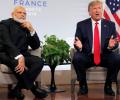
Trump on Wednesday said in a tweet that he was "ready, willing and able to mediate" between the two countries.

The army has long been deficient in artillery, the modern battlefield's most lethal killer, says Ajai Shukla.
The talks between the two armies are going to be held this week at multiple locations including Patroling point 14 (Galwan area), Patrolling point 15, and Hot Springs area, top government sources said.
Most of India's reserves for war in the mountains have been sucked in by the standoff with China. A large part of India's airpower has also similarly been committed on the eastern border. By moving these reserves to the China border, India has been weakened vis-a-vis Pakistan. All in all, the nightmare scenario for India of a two-front war may well come true, warns Colonel Anil A Athale (retd).

Dai Bingguo, who served as the China's boundary negotiator with India from 2003 to 2013, told Chinese media, "If the Indian side takes care of China's concerns in the eastern sector of their border, the Chinese side will respond accordingly and address India's concerns elsewhere."

Shah attacked Banerjee over the alleged culture of political violence in the state, saying the only industry that was flourishing in Bengal was that of "crude bombs and illegal weapons".
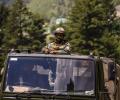
He said that following a build-up of troops, multiple transgressions and attempts to unilaterally change facts on the ground by China, there have been several levels of talks and a fair amount of communication to ensure that the matter can be resolved through negotiation and diplomacy.
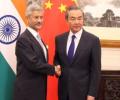
Wang said the two sides should follow the important consensus reached by the leaders of the two countries and strengthen the communication and coordination on the proper handling of the border situation through the existing channels so as to jointly maintain peace and tranquility in the border area, the Chinese foreign ministry said in a statement.

India-China relations have always attracted Parliament's attention and there have always been useful and productive and constructive discussions how to engage with China, notes Rup Narayan Das.
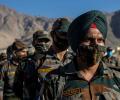
In a strong response to China's objection to development of infrastructure on the Indian side of the LAC, New Delhi also asserted that Beijing has no locus standi to comment on India's internal matters.

'The government will ensure that India's pride is not affected as far as the situation along Indo-China border is concerned'

Just like China wants Trump to lose the US presidential poll, it may want Modi to lose the Lok Sabha polls. So months before the 2024 elections, China may take possession of an important area, say one of the Char Dhams, warns Sanjeev Nayyar.
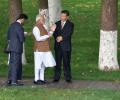
'The meeting marks the first tentative step in the effort to understand whether the two largest Asian nations can co-exist peacefully while realising their aspirations.' 'Caution and watchful wariness will dominate the effort of both sides,' says Jayadeva Ranade, former RA&W officer and China expert.
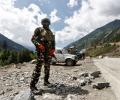
At a virtual media briefing, Ministry of External Affairs (MEA) Spokesperson Anurag Srivastava said disengagement of troops is a complex process which would require mutually agreed 'reciprocal actions'.

A group of shepherds were asked to vacate the land by troops of the PLA.

India's envoy had said that stand-off in Doklam saying it happened because Beijing tried to alter the "status quo" which it should not have.
'India needs to closely monitor the discussions at the UNSC and make counter-measures as this touches its core interests', points out Srikanth Kondapalli.

'Modi's recent decisions to improve India-China relations, adjust India's neighbourhood policies and to rebalance India's ties with the major powers are linked to his political agenda.' 'Of course, the good part is that this agenda is also in the national interest,' says Ambassador M K Bhadrakumar.
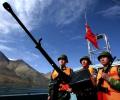
Both the Indian and Chinese armies have brought in more troops in sensitive locations like Demchok, Daulat Beg Oldie and areas around Galwan river as well as Pangong Tso lake in Ladakh, the sources said. The area around Galwan has been a point of friction between the two sides for over six decades.

China on Monday said Defence Minister A K Antony's visit Beijing has given both countries an opportunity to enhance their "strategic cooperative partnership" and jointly maintain peace and tranquillity in the border areas through increased military-to-military coordination.

India has told China that disengagement at all friction points is necessary to contemplate de-escalation of troops in eastern Ladakh even as the foreign ministers of the two countries agreed to establish a hotline for "timely" communication and exchange of views.

He also said it was important that even during the difficult moments of this "crisis" India has been communicating and engaging with China.
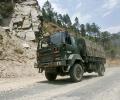
It is learnt that Defence Minister Rajnath Singh has conveyed to top military brass that there was no need for reviewing the implementation of any of the key projects along the Line of Actual Control (LAC) in Ladakh, Sikkim, Uttarakhand or in Arunachal Pradesh in view of the aggressive behaviour by Chinese troops in several sensitive areas.
Indian and Chinese troops remained engaged in an eyeball-to-eyeball situation in several disputed areas.
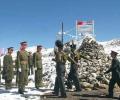
People familiar with the situation in the region said the two sides were engaged in trying to resolve the dispute, but there was no indication of a positive outcome yet as both the armies continued to bolster their positions in disputed areas of Pangong Tso and Galwan Valley and Demchok.

'Both have a very nationalistic view of foreign policy.' 'They think they are shrewd and clever diplomats.'
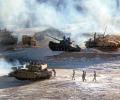
'The Chinese are only about 160-170 km behind.' 'It will not take much time for them to bring their troops back, considering that they have better infrastructure -- and the weather is now favourable.' 'They can move in much faster as the terrain favours them.'

Members of the Congress also walked out of the Lok Sabha and staged a sit-in in the Parliament House complex after they were not allowed to speak following a statement by Defence Minister Rajnath Singh on the border standoff with China in eastern Ladakh.

The brigade that conducted the drills was from the PLA's Tibet Military Command and is one of China's two plateau mountain brigades.
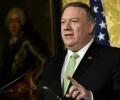
"I've spoken with Foreign (External Affairs) Minister (S) Jaishankar a number of times about this (Chinese aggressive actions). The Chinese took incredibly aggressive actions. The Indians have done their best to respond to that," Pompeo told reporters at a news conference in Washington, DC.
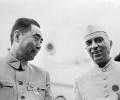
The Indians felt that if they acceded to Chinese claims in Ladakh, Beijing would simply be emboldened to press for further concessions in the future. A revealing excerpt from India And The Cold War.

India and China on Monday decided to deepen bilateral defence ties and maintain peace and tranquillity at the Line of Actual Control besides strengthening cooperation against terror, including at the international level.

Referring to allegations that it was "silly for China" not to have names for various counties and inventing them for six places in Arunachal Pradesh, an op-ed article in the state-run Global Times said "these comments are absurd".
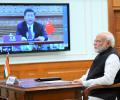
'If Asia does become a Chinese dominated space, it will not only be because India failed to get its economic act together but also because it did not stand up for its democratic credentials,' warns Shyam Saran, the former foreign secretary.
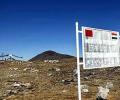
The move was aimed at 'reaffirming China's claim over the state'. China claims the state as 'South Tibet'.

'If the Chinese military gets hold of some western sectors on the India-China boundary, it will give them added military advantage.'
 © 2026 Rediff.com - Advertise with us - Disclaimer - Privacy Policy - Sitemap - Feedback - About us - Terms of use - Grievances